
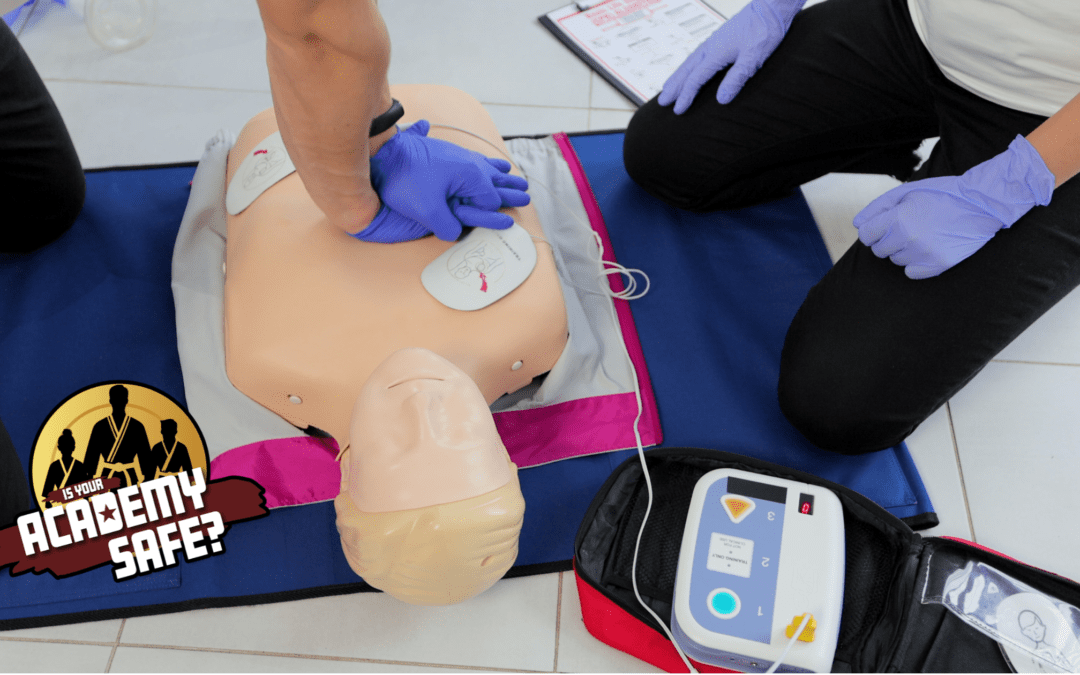
When people walk into a gym, martial arts academy, or fitness facility, they expect a place that supports health, strength, and personal growth. They do not expect a sudden cardiac emergency, but those incidents do happen during physical activity, which is why gyms need more than great programming and equipment; they need emergency readiness, including accessible defibrillators and trained staff.
At Academy Safe, we believe safety is part of leadership. A gym that is prepared to respond to a cardiac event sends a clear message to families, students, and members: your well-being matters here.
Why AEDs Matter
An automated external defibrillator, or AED, is a device that analyzes heart rhythm and can advise or deliver a shock when a person is in sudden cardiac arrest. The American Heart Association statement on health and fitness facilities explains that early recognition, CPR, and early defibrillation are central links in the chain of survival, and it notes that time from collapse to defibrillation is the single greatest determinant of survival in shockable cardiac arrest.
That timing matters because survival rates decline by 7 to 10 percent for every minute defibrillation is delayed, according to the American Heart Association guidance for health and fitness facilities. In witnessed ventricular fibrillation arrests, survival has been reported as high as 90 percent when defibrillation happens within the first minute.
Heart incidents during activity
Cardiac emergencies in exercise settings are not theoretical. A study of 849 sudden cardiac arrests at public indoor facilities in Seattle and King County found that 52 occurred at traditional exercise facilities and 84 occurred at alternative exercise facilities, and among cases where activity data was available, 77 percent happened during exercise, compared with 18 percent after exercise and 4 percent before exercise.
The same study found survival rates of 56 percent at traditional exercise facilities and 45 percent at alternative exercise facilities, compared with 34 percent at non-exercise facilities, which researchers linked in part to early CPR and AED access. The most common activities associated with these events included basketball at 20.5 percent, dancing and general workouts at 11.6 percent each, treadmill use at 8.9 percent, tennis at 6.3 percent, bowling at 5.4 percent, and swimming at 4.5 percent.
Older research cited by the American Heart Association also reported that in a survey of 65 randomly chosen Ohio health and fitness facilities, sudden cardiac arrest or heart attack occurred in 17 percent of facilities during a five-year period, while only 3 percent had an AED on site. The same statement cites a large commercial chain database of more than 2.9 million members that recorded 71 deaths over two years, a rate of 1 death per 100,000 members per year, and noted that nearly half of exercise-related deaths occurred among members who exercised less than once a week.
Why training matters
Having an AED on the wall is not enough. The American Heart Association and American College of Sports Medicine guidance emphasizes that emergency equipment alone does not save lives, and that facilities need written emergency policies, designated CPR-trained first responders present during operating hours, staff trained to recognize cardiac arrest, and regular drills at least once every three months.
This is especially important in gyms and martial arts schools because fast, calm action depends on practice. Staff should know who calls 911, who starts CPR, who retrieves the AED, who meets EMS at the entrance, and how to keep the area clear so care can begin immediately.
Academy Safe’s mission
At Academy Safe, our goal is to create a culture where martial artists can train without fear, one that nurtures personal growth, discipline, and respect. By implementing these strict safety measures, we aim to prevent abuse and safeguard the well-being of students of all ages.
That mission includes physical safety as well as organizational safety. Emergency preparedness, including AED access and proper staff training, helps create an environment where students, members, and families know their academy takes protection seriously.
What gyms should do now
Gyms, fitness centers, and martial arts academies should treat AED readiness as a core part of operations, not an optional upgrade. American Heart Association guidance encourages effective AED placement and use at health and fitness facilities, especially larger facilities, those serving clinical populations, and those where EMS response time to first shock is expected to exceed five minutes.
Strong next steps include:
- Install an AED in an easy-to-access, clearly marked location.
- Train staff in CPR and AED use, and make sure trained responders are present during all operating hours.
- Create written emergency response procedures for sudden cardiac arrest.
- Practice drills regularly so staff can respond without hesitation.
- Coordinate your emergency plan with local EMS when possible.
A safe gym is not just one that prevents avoidable harm in daily operations. It is also one that is ready to act in the moments that matter most. Reach out to Academy Safe for more information about the purchase and training for a defibrillator!
Find a Verified Academy, or Get Yours Listed
Academy Safe is a 501(c)(3) nonprofit that runs the Martial Arts Safety Registry for the United States and Canada. Parents can find an accredited academy near you. Academy owners can register your academy to get your coaches verified and your school listed.
Want to support this work? Make a donation to Academy Safe.